


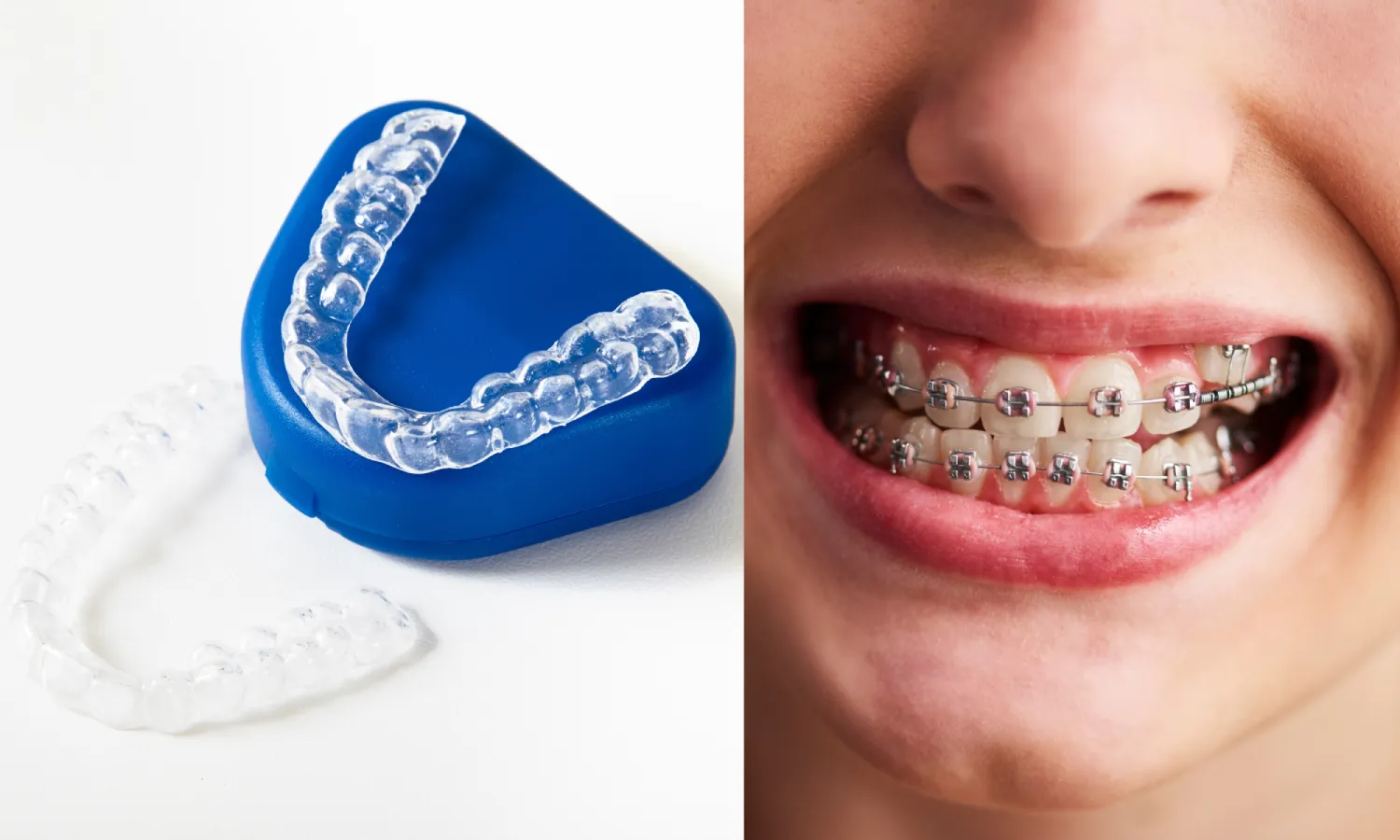
So you've decided to straighten your teeth. That's brilliant, but now comes the hard part: should you go with Invisalign or traditional braces?
This is a question we discuss with patients every day at our dental clinic. The good news is that both treatments are highly effective and can achieve a straighter, healthier smile when carefully planned.
The right option depends on your individual case, your lifestyle, and what matters most to you. Some patients prefer a discreet solution. Others need treatment that is better suited to more complex alignment issues.
In this guide, we compare Invisalign and braces side by side to help you understand the differences and decide which is right for you.
Is Invisalign Better Than Braces? Pros and Cons Compared

There is no single “better” option. Both Invisalign and braces are highly effective when used for the right case.
The key difference lies in what matters most to you: appearance, convenience, complexity of treatment, and budget.
Here is how they compare.
Is Invisalign Right for You?
Invisalign is a clear, removable alternative to traditional braces for straightening teeth. It’s ideal for patients who want flexibility and a discreet treatment option. Invisalign works by using a series of custom-made aligners that gradually shift teeth into proper alignment. This system can effectively address a range of orthodontic issues, including overbites and gaps between teeth.
Are Braces the Better Choice for Your Smile?
Braces are a fixed and highly reliable way to straighten teeth. There are different types of braces, from traditional metal braces to more invisible lingual braces. They are often recommended for more complex alignment or bite concerns, such as underbite or overbite. Braces are frequently used to fix crooked teeth and improve facial symmetry.

Which Treatment Option Works Faster for Straighter Teeth: Invisalign or Braces?
Speed is one of the first questions we’re asked at Zental. The honest answer is that treatment time depends far more on your individual case than on whether you choose Invisalign or braces.
Invisalign is often perceived as quicker, largely because it is commonly recommended for mild to moderate alignment concerns. In these cases, treatment may take between 6 and 18 months.
Braces are frequently chosen for more complex alignment and bite correction. These cases naturally require more time, often between 12 and 24 months, depending on the movements involved.
When we compare patients with similar starting points, the difference in overall treatment time is often minimal. In certain complex cases, braces can actually move teeth more efficiently due to the level of control they provide.
What matters most is not the appliance itself, but the diagnosis and treatment planning behind it.

What Factors Affect Treatment Speed?
The type of treatment you choose does matter. However, in most cases, the starting position of your teeth and bite makes a bigger difference.
Before we give you a timeline at Zental, we look carefully at your teeth, your bite, and how much movement is needed. This allows us to give you a realistic estimate based on you, not just the appliance.
Here are the main things that affect treatment time:
- How complex your case is: If you only have a small gap or mild crowding, treatment may be fairly quick. If your teeth are very crowded or your bite needs correcting, it will take longer. The more movement required, the more time your teeth need to shift safely.
- How well you follow instructions: Invisalign only works if it is worn for 20 to 22 hours each day. If aligners are left out too often, your teeth will not move as planned, and treatment will slow down. Braces are fixed in place, so they continue working all the time.
- The type of movement needed: Some tooth movements are simple. Others are more complex. For example, turning a twisted tooth or correcting how the top and bottom teeth meet takes more time than closing a small space.
- Your age: Teeth can be straightened at almost any age. However, younger patients may see slightly faster movement because their bones are still developing. In adults, movement can take a little longer, but results are just as effective.
- Avoiding delays: Lost aligners, broken brackets, or missed appointments can add extra weeks to treatment. Taking care of your appliance and attending reviews helps keep everything on schedule.
At your consultation, we will explain clearly how long we expect your treatment to take and why. Our goal is not just to move teeth quickly, but to achieve a healthy, stable result that lasts.

Average Cost of Invisalign and Braces in the UK
The cost of braces is often one of the biggest deciding factors when choosing orthodontic treatment. Many patients also compare the cost of Invisalign with traditional fixed braces to understand which option offers the best value for their needs.
As a general guide, mild cases cost less because fewer movements and shorter treatment times are involved. More complex cases require longer treatment and, therefore, a higher investment.
Orthodontic fees are generally higher in major cities, particularly London. Below is a broad guide to private treatment costs.
What Is Included in the Price?
Not all clinics structure their pricing in the same way. Some headline fees may not include:
- X-rays and scans
- Review appointments
- Emergency visits
- Retainers after treatment
At Zental, we believe in transparent pricing. During your consultation, we provide a clear breakdown of what is included, so you understand the full investment before starting treatment.
We also offer flexible monthly payment options to make treatment more manageable.
Invisalign or Braces: Which One Should I Choose?
The right choice depends on your teeth, your lifestyle, and what matters most to you. Our patients have achieved great results with treatments. You can take a look at our before-and-after cases for Invisalign and braces.
Some patients prioritise discretion. Others want the most powerful fixed option available. The key is matching the treatment to your clinical needs and daily habits.
Invisalign may suit you if:
- Your alignment concerns are mild to moderate
- You want a discreet, nearly invisible option
- You are confident you can wear aligners for 20 to 22 hours each day
- You would prefer no food restrictions
- Easy brushing and flossing are important to you
- You have professional or social commitments where visible braces would concern you
- Fewer in-clinic visits would suit your schedule
Braces may be the better choice if:
- Your case is more complex
- Significant rotations or bite correction are required
- You would prefer a fixed solution that works continuously
- Budget is your main priority
- You want maximum control over tooth movement
- You are comfortable with visible treatment, or interested in ceramic braces or lingual options

Why a Consultation Matters
What works well for one person may not be suitable for another. Two patients can appear similar at first glance but require very different treatment plans once their bite and tooth positioning are assessed properly.
At Zental, we carry out a detailed clinical examination before making any recommendation. We assess your teeth, your bite, your jaw position, and your long-term stability. We then explain clearly which options are appropriate for your case and why.
There is no pressure to decide immediately. Our role is to give you clarity and confidence, so you can make an informed decision about your smile.
Ready to find out which option suits you best? Book your consultation at Zental and let's start the conversation. No pressure, just clear answers and a plan that puts you first.
FAQ
Are braces more painful than Invisalign?
Both treatments can cause temporary discomfort, especially when adjustments are made or when you move to a new aligner. Invisalign is often described as feeling like pressure or tightness. Braces may cause some rubbing against the cheeks. Any soreness usually settles within a few days.
Can I switch from braces to Invisalign?
In some cases, yes. However, switching partway through treatment can affect timing and cost. If flexibility is important to you, it is best to discuss this during your initial consultation so your treatment can be planned properly.
Is Invisalign as effective as braces?
In many cases, yes. Invisalign can treat mild to moderate alignment and bite issues very effectively. However, for more complex cases, traditional braces may offer better control.
Is Invisalign more expensive than traditional braces?
Invisalign can sometimes cost slightly more, but this depends on the complexity of your case and treatment length. During your consultation, your orthodontist will explain the best option and the costs involved.
Which is less noticeable: Invisalign or braces?
Invisalign is usually less noticeable because the aligners are clear and removable. Braces are more visible, although ceramic and tooth-coloured options are available.
Can Invisalign treat complex dental issues the same way as braces?
Invisalign can treat many bite and alignment problems, but severe or complex cases may still require fixed braces for the best result.
How long does Invisalign take compared to braces?
Treatment time depends on the case. Some mild cases with Invisalign can be completed quickly, but more complex cases may take a similar amount of time as braces.


